Most resumes are not being carefully read during the first review.
They’re being scanned.
That distinction matters more than most candidates realize.
A lot of job seekers assume recruiters are deeply evaluating every bullet point, analyzing experience thoroughly, and comparing qualifications line by line.
In reality, the first pass through a resume is often extremely fast.
Recruiters are usually trying to answer one question first:
“Does this candidate look relevant enough to continue reviewing?”
That initial decision can happen in seconds.
Which means the structure and clarity of a resume often matter before the actual details do.
The First Resume Scan Is About Reducing Uncertainty
Recruiters are not initially searching for the “perfect” candidate.
They are trying to process large volumes of information quickly and confidently.
During the first scan, recruiters are often looking for:
- role alignment
- recent relevant experience
- clear positioning
- readable formatting
- obvious qualifications
- low-friction structure
If a resume feels difficult to process immediately, recruiters often move on before fully evaluating the candidate.
That does not necessarily mean the candidate is unqualified.
It means the resume created hesitation during a very fast filtering stage.
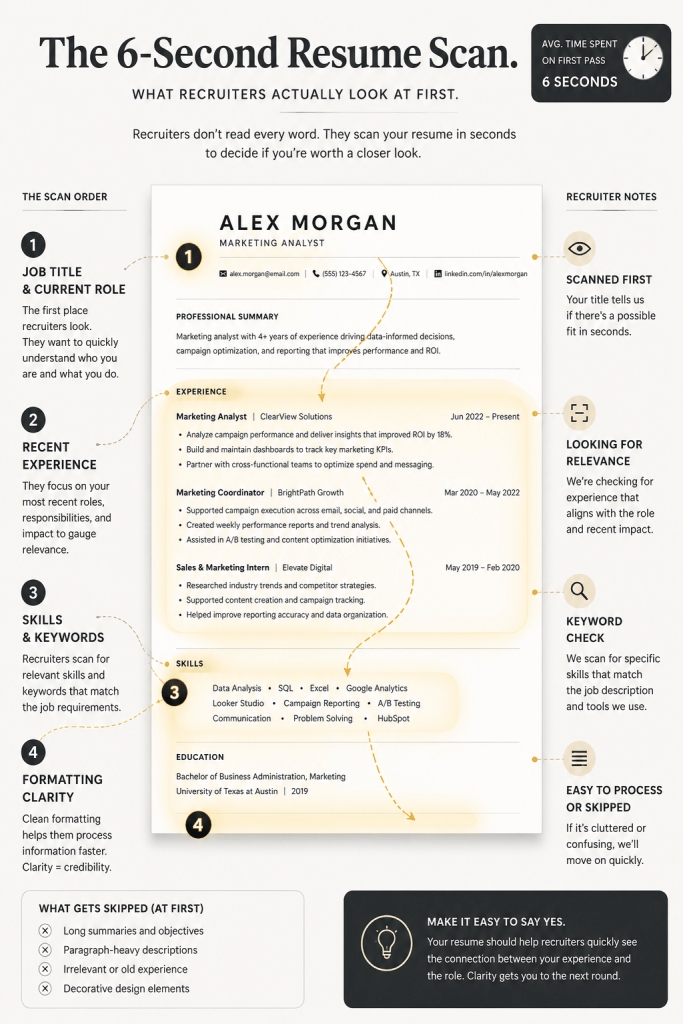
What Recruiters Usually Look At First
While every recruiter is different, resume scanning patterns are often surprisingly consistent.
Most first scans focus heavily on a few areas.
1. Job Title & Current Role
This is usually one of the first things recruiters look for.
Why?
Because recruiters are trying to establish relevance quickly.
They want to understand:
- what the candidate currently does
- whether the experience aligns with the role
- how closely the background matches the job opening
Unclear titles create friction immediately.
Example:
Weak:
“Business Specialist”
Stronger:
“Operations Coordinator”
“Marketing Analyst”
“Customer Success Manager”
Specific titles reduce interpretation effort.
2. Most Recent Experience
Recruiters often prioritize recent experience heavily.
Not because older experience never matters.
But because recent work usually reflects:
- current skills
- current responsibilities
- current career direction
This is why:
- cluttered older experience
- overly long job histories
- unrelated past roles
can distract from stronger recent qualifications.
3. Resume Structure & Formatting
Formatting affects comprehension speed more than most people expect.
Recruiters are often scanning for:
- spacing
- readability
- organization
- visual clarity
Dense formatting creates friction quickly.
Common formatting issues:
- giant text blocks
- inconsistent spacing
- crowded margins
- excessive bolding
- difficult fonts
- overdesigned templates
- large summary paragraphs
Simple formatting usually performs better because it reduces cognitive effort.
4. Skills & Keywords
This is where ATS myths often create confusion.
Recruiters are not usually impressed by keyword stuffing.
They are looking for:
- relevant terminology
- role alignment
- believable experience connections
A clean skills section can help quickly reinforce fit.
But long lists of disconnected buzzwords often weaken credibility instead.
5. Bullet Point Clarity
This is one of the most common resume weaknesses.
A lot of bullets explain responsibilities without showing:
- scope
- contribution
- outcomes
- context
Weak bullet:
“Responsible for customer service and communication.”
Stronger bullet:
“Handled high-volume customer support requests while maintaining consistent response times across multiple communication channels.”
The goal is not sounding impressive.
The goal is reducing ambiguity.
What Gets Skipped During Fast Resume Scans
This surprises many candidates.
Recruiters often do NOT initially focus on:
- long professional summaries
- overly detailed objective statements
- paragraph-heavy explanations
- decorative design elements
- personal branding language
- “creative” formatting choices
These sections frequently slow understanding instead of improving it.
Eye-Tracking Style Resume Behavior
Most resume scans follow a rough visual pattern.
Recruiters often look:
- top of the resume
- current role/title
- recent experience
- company names
- skills section
- formatting consistency
This is why clarity near the top of the document matters so much.
If the top third of the resume feels:
- confusing
- vague
- dense
- visually cluttered
the rest of the document may never receive serious attention.
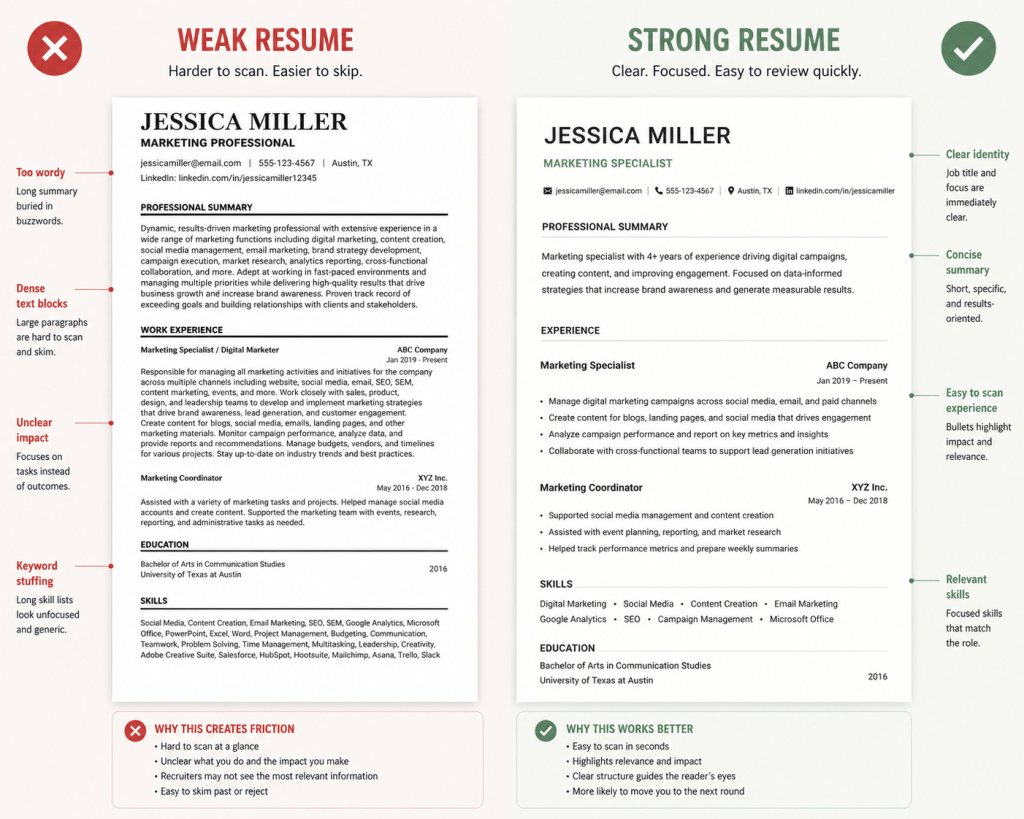
Weak vs Strong Resume Presentation
A weak resume often feels:
- crowded
- vague
- difficult to scan
- inconsistent
- overexplained
A stronger resume usually feels:
- structured
- concise
- predictable
- easy to navigate
- visually calm
This difference matters because recruiters are processing information under time pressure.
Reducing friction is extremely important.
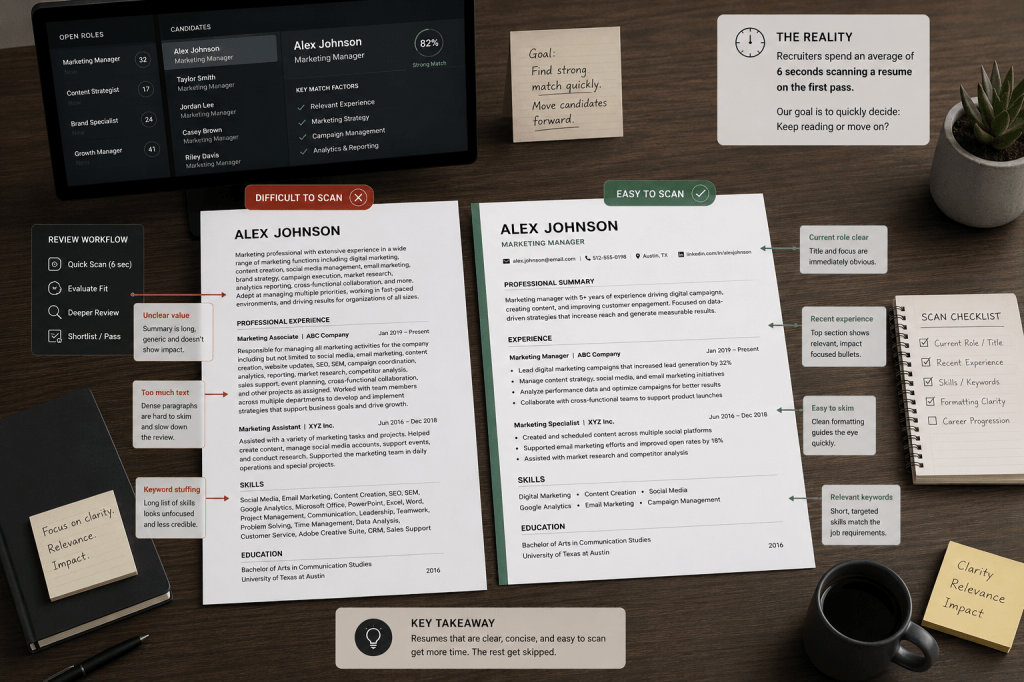
Why Overdesigned Resumes Often Underperform
Many candidates try to “stand out” visually.
But in high-volume hiring environments, unusual formatting can backfire.
Complex layouts often:
- reduce readability
- confuse ATS parsing
- slow scanning speed
- create visual clutter
Most recruiters prefer resumes that are:
- clean
- structured
- predictable
- easy to process quickly
Simple resumes are not boring.
They are efficient.
The Biggest Resume Mistake Most Candidates Make
Most candidates try to maximize information.
Strong resumes prioritize:
comprehension speed.
Those are different things.
Adding:
- more text
- more keywords
- more explanations
- more design elements
does not necessarily improve a resume.
In many cases, it creates more friction.
What Actually Helps During The First Scan
The strongest resumes usually:
- communicate role alignment quickly
- prioritize readability
- reduce ambiguity
- use concise bullets
- keep formatting consistent
- make experience easy to interpret
This increases the likelihood that recruiters continue reviewing instead of moving on.
Final Thoughts
Most resumes are not being rejected because candidates are completely unqualified.
They are being filtered during a very fast evaluation process where:
- clarity matters
- readability matters
- structure matters
- relevance matters
The goal of a resume is not to impress recruiters with complexity.
The goal is helping recruiters understand your value quickly without unnecessary friction.
Before your next application, review your resume the same way a recruiter would:
fast, practical, and under time pressure.
Use the free Resume Application Checklist before your next application.
 thediyjobsystem
Leave a comment