Few parts of the job application process create more confusion than ATS systems.
A lot of candidates believe their resumes are being instantly rejected by software before any human ever sees them.
That fear has created an entire industry of:
- keyword hacks
- resume “tricks”
- ATS optimization myths
- overcomplicated templates
- extreme tailoring advice
The problem is that some of this advice actually makes resumes worse.
Not because ATS systems never matter.
But because candidates often optimize for imagined software behavior instead of improving clarity for real recruiters.
And in modern hiring, those are not always the same thing.
What ATS Systems Actually Do
Most ATS platforms are primarily organizational tools.
Companies use them to:
- store applications
- sort candidates
- search resumes
- track hiring pipelines
- manage communication
They are not usually functioning like fully autonomous rejection machines aggressively eliminating every imperfect resume.
That is one of the biggest misconceptions online.
In many hiring environments, recruiters still review applications manually after initial filtering stages.
The larger issue is often not:
“The ATS rejected me.”
It’s:
“My resume created confusion or friction during fast review.”
That distinction matters.
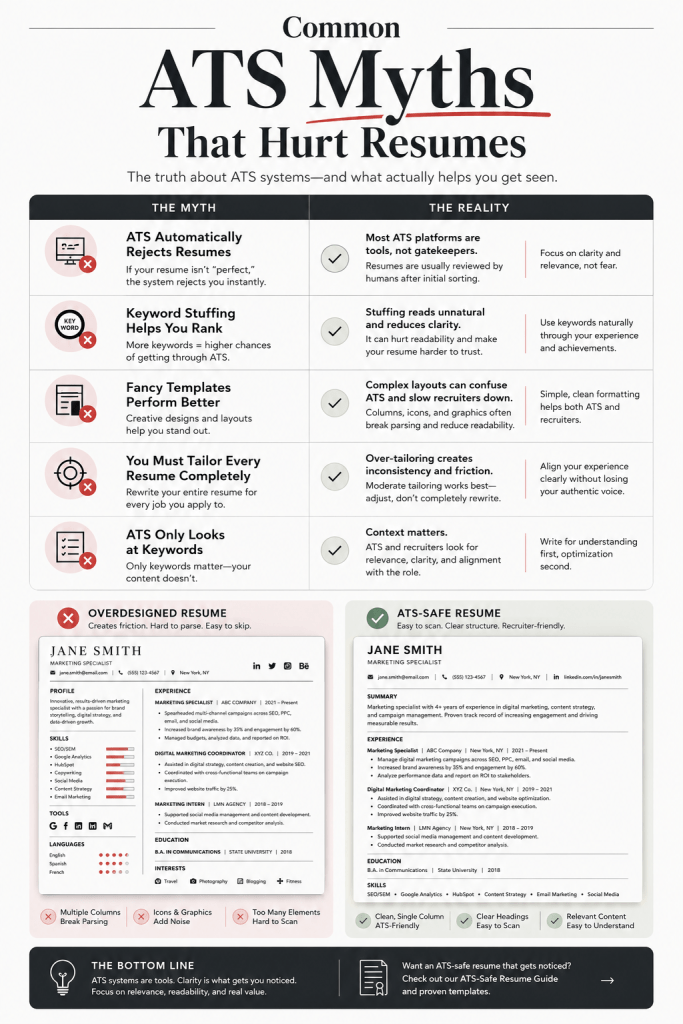
Myth #1: “The ATS Automatically Rejects Most Resumes”
This is probably the most widespread ATS myth.
Candidates often imagine ATS systems behaving like rigid pass/fail tests.
In reality, hiring systems vary significantly between companies.
Some recruiters:
- manually review large candidate pools
- search databases using keywords
- prioritize referrals
- scan resumes quickly before making decisions
Others may use filtering questions or screening tools.
But the process is usually more nuanced than:
“the software instantly rejected your resume.”
A lot of resumes struggle because:
- the experience is unclear
- the formatting is difficult to scan
- the role alignment is weak
- the resume feels overly broad
- the structure slows understanding
Those issues are often mistaken for ATS rejection.
Myth #2: Keyword Stuffing Improves Your Chances
This is one of the most damaging pieces of resume advice online.
Candidates sometimes overload resumes with:
- repeated keywords
- giant skills sections
- copied job descriptions
- long lists of tools and buzzwords
thinking it will “beat” ATS systems.
But excessive keyword stuffing often creates:
- awkward reading flow
- reduced clarity
- obvious manipulation
- lower credibility
Recruiters still need to understand the resume quickly.
If the document feels unnatural or overloaded with terminology, it can become harder to evaluate.
Relevant keywords do matter.
But they should appear naturally through:
- job titles
- experience descriptions
- real responsibilities
- actual tools used
Not through repetition for the sake of optimization.
Myth #3: Fancy Resume Templates Help You Stand Out
A lot of modern resume templates are visually impressive.
The problem is that many prioritize aesthetics over readability.
Complex templates often include:
- multiple columns
- icons
- graphics
- progress bars
- unusual layouts
- decorative design elements
These can create problems for both:
- ATS parsing
- recruiter scanning behavior
More importantly, they often slow comprehension.
Recruiters reviewing high application volume usually prefer resumes that feel:
- predictable
- clean
- structured
- easy to navigate quickly
Simple formatting is often more effective than highly designed templates.
Especially for online applications.
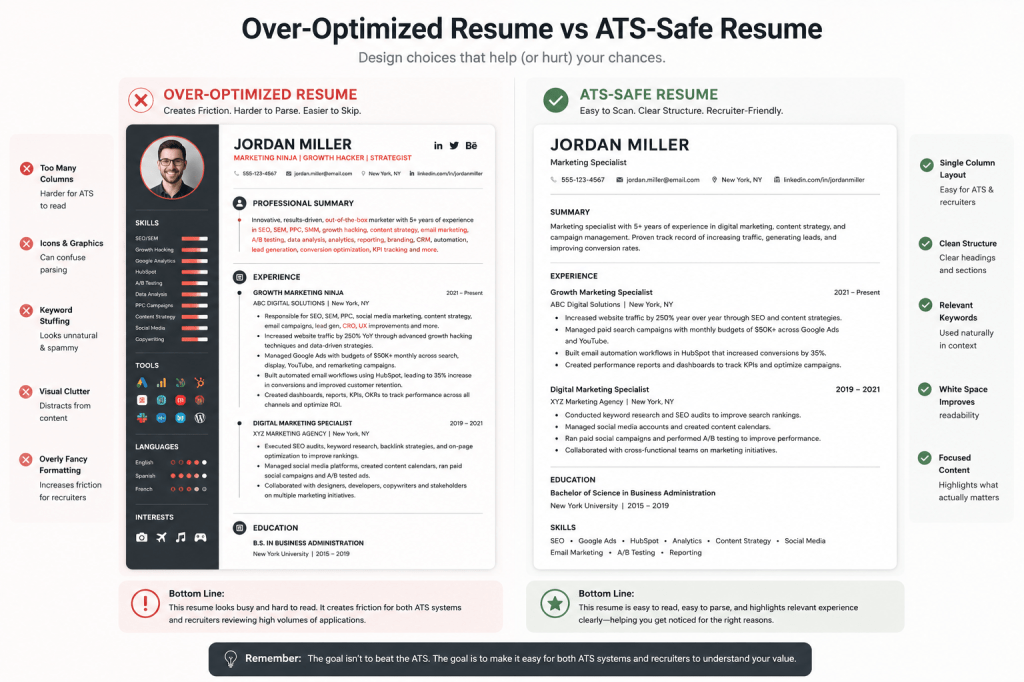
Myth #4: Columns and Icons Always Improve Resume Design
This connects closely to template problems.
Candidates often add:
- sidebars
- icons
- visual skill meters
- split-column layouts
because they appear modern.
But these elements can sometimes:
- reduce readability
- break parsing structure
- compress important information
- create visual clutter
The strongest resumes are usually optimized for:
comprehension speed.
Not decoration.
A resume should help recruiters process information quickly with minimal effort.
Myth #5: Every Resume Must Be Completely Rewritten For Every Job
Tailoring matters.
But many candidates take this advice too far.
Over-tailoring often leads to:
- robotic wording
- keyword stuffing
- inconsistent voice
- exaggerated alignment
- awkward phrasing
A resume does not need to become an entirely different document for every application.
Usually, moderate tailoring works best:
- adjusting role emphasis
- prioritizing relevant experience
- slightly refining terminology
- aligning skills naturally
Constantly rewriting resumes from scratch often creates more confusion than clarity.
Why ATS Fear Makes Resumes Worse
One hidden problem with ATS anxiety is that candidates begin optimizing for software instead of communication.
They:
- over-edit
- over-format
- overstuff keywords
- overcomplicate templates
- obsess over “beating the system”
Ironically, this often increases friction during actual human review.
Most recruiters are trying to answer simple questions quickly:
- What does this person do?
- Is their experience relevant?
- Does the resume feel clear and credible?
- Is this easy to evaluate?
That process matters more than many ATS myths suggest.
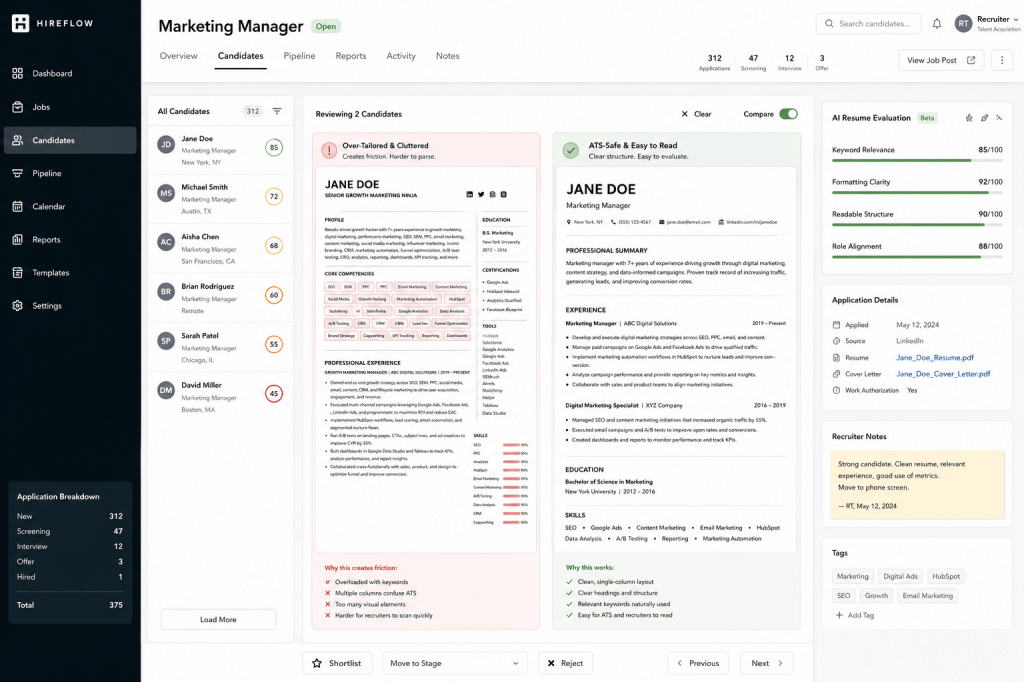
What Actually Helps Resumes Perform Better
The strongest resumes usually focus on:
- clarity
- readable formatting
- relevant experience
- concise bullets
- consistent structure
- believable positioning
They reduce uncertainty instead of trying to manipulate systems.
Simple resumes often outperform overly optimized ones because they are easier to review quickly.
A Better Way To Think About ATS Systems
Instead of asking:
“How do I beat the ATS?”
it is usually more useful to ask:
“How do I make my resume easier to understand quickly?”
That shift changes the entire approach.
Because modern hiring is heavily volume-driven.
And in high-volume environments, clarity matters enormously.
Final Thoughts
ATS systems are real.
But many of the fears surrounding them are exaggerated or misunderstood.
A lot of resume problems blamed on ATS software are actually:
- clarity problems
- formatting problems
- positioning problems
- readability problems
- over-optimization problems
The goal is not building a resume that looks perfectly optimized for software.
The goal is building a resume that:
- recruiters can understand quickly
- feels credible
- aligns clearly with the role
- reduces unnecessary friction
That usually matters more than chasing ATS “hacks.”
If you’re actively applying right now, start with an ATS-safe structure before worrying about advanced optimization strategies.
Use the ATS-safe guide and templates before your next application.
 thediyjobsystem
Leave a comment