There is more resume advice online than ever before.
And a surprising amount of it quietly creates worse resumes.
Not because candidates are lazy or unqualified.
But because modern resume advice often encourages people to optimize for:
- attention
- aesthetics
- algorithms
- “standing out”
- sounding impressive
instead of optimizing for clarity during real hiring situations.
That distinction matters more than most people realize.
Because recruiters are usually not reviewing resumes under ideal conditions.
They are often:
- reviewing high application volume
- switching between multiple roles
- scanning quickly
- trying to reduce uncertainty fast
In that environment, resumes that are:
- easy to process
- easy to understand
- clearly relevant
usually perform better than resumes trying aggressively to appear unique.
The Internet Rewards Attention, Not Practical Hiring Advice
A lot of resume content online is designed to:
- go viral
- generate clicks
- create fear
- promise shortcuts
- sound authoritative
That environment naturally produces advice like:
- “Your resume has 6 seconds!”
- “This one trick beats ATS systems!”
- “Stand out from every other candidate!”
- “Recruiters hate these words!”
The problem is that hiring is usually more nuanced and less dramatic than internet content makes it seem.
Most resumes do not fail because of one catastrophic mistake.
They fail because small friction points accumulate:
- unclear positioning
- difficult formatting
- vague bullets
- clutter
- over-editing
- weak relevance
That process is less exciting than “resume hacks,” but it is often closer to reality.
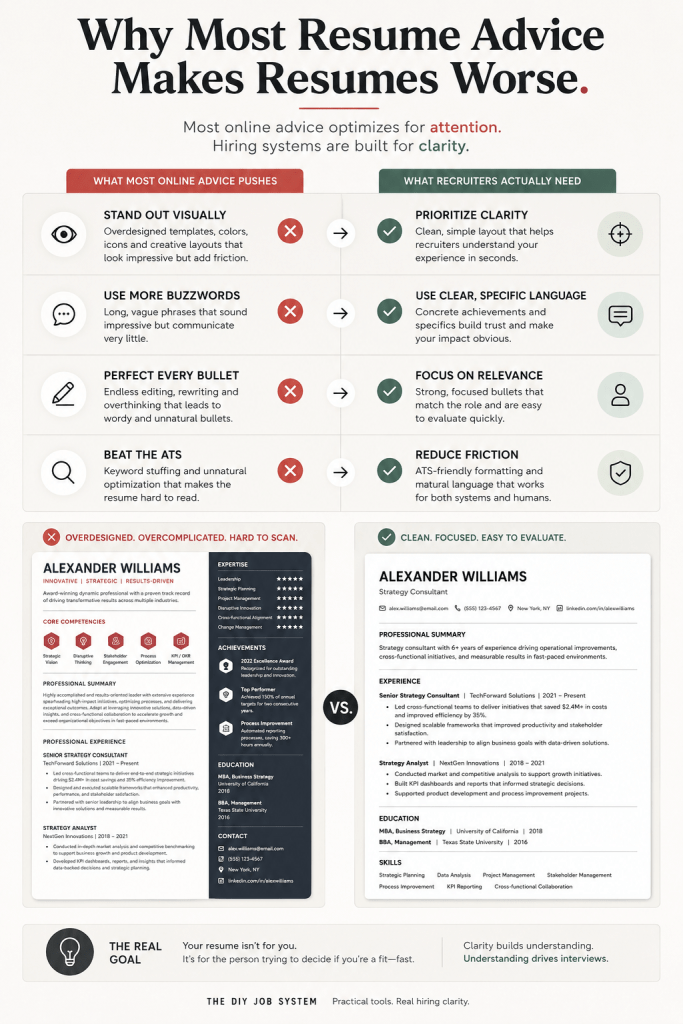
“Stand Out” Advice Is Frequently Misunderstood
This is one of the biggest problems online.
Candidates are constantly told:
“You need to stand out.”
So they:
- overdesign resumes
- add graphics
- use unusual templates
- write exaggerated summaries
- force creative wording
- add excessive branding
Ironically, many of these changes reduce clarity.
Recruiters are usually trying to answer practical questions quickly:
- What does this person do?
- Is their experience relevant?
- Can I understand this resume easily?
- Does this candidate fit the role?
If a resume becomes visually or structurally confusing, standing out stops helping.
In many cases:
clarity stands out more than creativity.
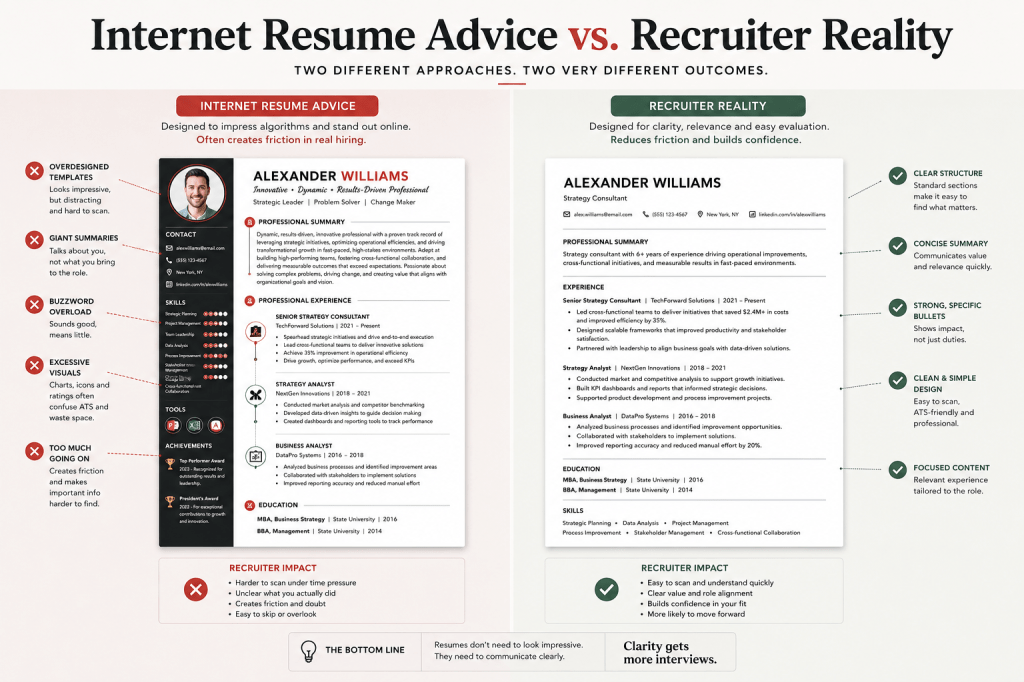
Overdesigned Resumes Often Create Friction
This surprises many candidates.
A visually impressive resume is not always an effective hiring document.
Online resume advice frequently encourages:
- columns
- graphics
- icons
- progress bars
- unusual layouts
- heavy color usage
These can:
- reduce readability
- complicate ATS parsing
- slow scanning speed
- compress information awkwardly
Especially in online applications, simpler formatting usually performs better because it reduces cognitive load.
Recruiters often prefer resumes that feel:
- predictable
- structured
- easy to navigate quickly
not visually complicated.
Buzzword Stuffing Makes Resumes Harder To Trust
A lot of resume language online sounds polished but communicates very little.
Phrases like:
- “results-driven professional”
- “dynamic team player”
- “strategic thought leader”
- “innovative problem solver”
appear everywhere.
The issue is not that these phrases are always wrong.
The issue is that they are usually too vague to create understanding.
Strong resumes tend to rely more on:
- clear responsibilities
- specific examples
- understandable achievements
- readable bullets
instead of abstract corporate language.
Recruiters generally trust clarity more than buzzwords.
Endless Editing Often Weakens Resumes
This is another hidden problem caused by internet advice.
Candidates start:
- rewriting every bullet repeatedly
- changing formatting constantly
- swapping templates every week
- chasing perfect wording
- obsessing over tiny details
Eventually the resume becomes:
- inconsistent
- overstuffed
- awkwardly optimized
- harder to read
At some point, additional editing creates diminishing returns.
Most strong resumes are not perfect.
They are:
- clear
- credible
- role-aligned
- readable under time pressure
That is usually enough.
ATS Fear Makes Everything Worse
Many candidates now approach resume writing with extreme anxiety about ATS systems.
This often leads to:
- keyword stuffing
- robotic phrasing
- unnatural repetition
- over-tailoring
- cluttered skills sections
Ironically, these changes can make resumes feel less human and less readable during actual recruiter review.
ATS systems matter.
But many online explanations dramatically oversimplify how hiring systems actually work.
A resume still needs to make sense to people.
Recruiters Usually Prioritize Clarity Over Cleverness
This is probably the most important point.
Recruiters are not awarding points for:
- sounding the most impressive
- using the most sophisticated language
- having the most visually unique layout
They are usually prioritizing:
- speed of understanding
- role relevance
- readability
- confidence in the candidate’s fit
A resume that communicates clearly under fast review conditions often outperforms one trying aggressively to “stand out.”
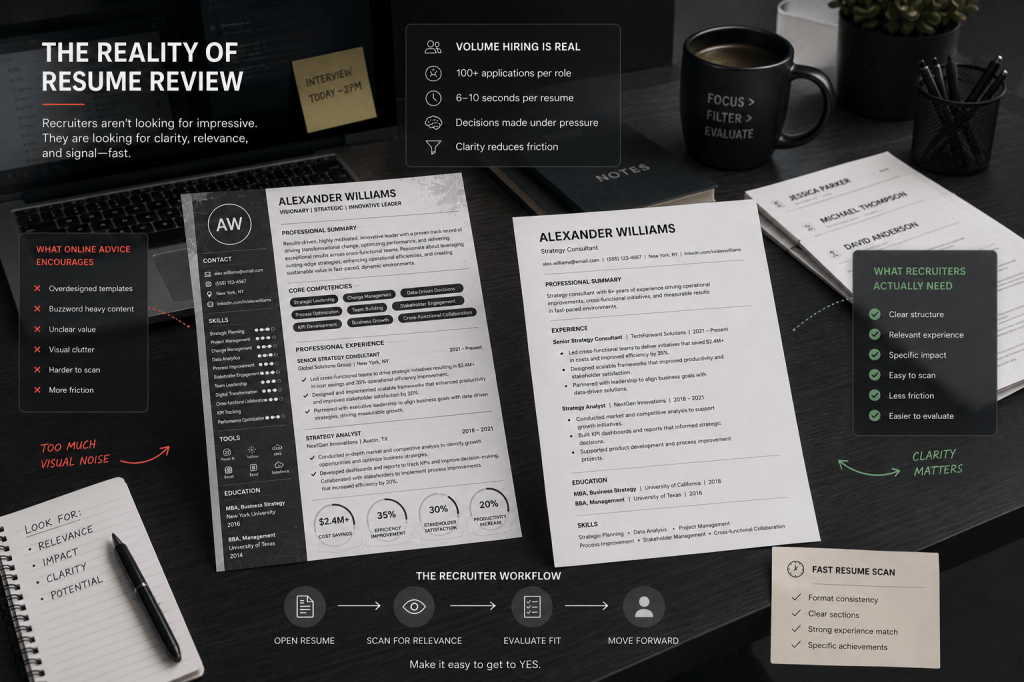
What Actually Tends To Help Resumes
The strongest resumes usually:
- use clean formatting
- prioritize readability
- avoid excessive design
- keep bullets concise
- communicate role alignment quickly
- reduce ambiguity
- feel easy to evaluate
They make recruiters work less.
That matters enormously in high-volume hiring environments.
A Better Way To Think About Resume Writing
Instead of asking:
“How do I make my resume look impressive online?”
it is often more useful to ask:
“How do I make my experience easier to understand quickly?”
That mindset changes the entire process.
Because modern hiring is heavily volume-driven.
And in volume-driven systems, reducing friction matters.
Final Thoughts
A lot of online resume advice unintentionally encourages candidates to:
- overcomplicate
- overdesign
- over-optimize
- over-edit
The result is often resumes that look polished on the surface but become harder to evaluate quickly.
The goal of a resume is not to win internet design competitions.
The goal is helping recruiters understand:
- who you are
- what you’ve done
- why you fit the role
without unnecessary friction.
Simple, readable, recruiter-friendly resumes consistently outperform resumes trying too hard to appear exceptional.
If you’re actively applying right now, focus on clarity before optimization.
The ATS-safe templates and resume frameworks in The DIY Job System were built around that principle.
Use the free Resume Application Checklist before your next application.
 thediyjobsystem
Leave a comment