Most resumes are not being carefully studied line-by-line the first time they are opened.
They are usually being scanned quickly.
That’s an important distinction.
In high-volume hiring environments, recruiters are often trying to answer a few practical questions fast:
- What does this person do?
- Is their experience relevant?
- Is this resume easy to evaluate?
- Should I continue reviewing this candidate?
Because of that, certain resume problems become noticeable almost immediately.
And surprisingly, many of the biggest mistakes are not dramatic.
They are small friction points that make resumes harder to process under time pressure.
Here are some of the most common ones recruiters tend to notice quickly.
1. Vague Bullet Points
This is probably one of the most widespread problems.
A lot of resumes contain bullets like:
- “Responsible for various tasks”
- “Worked with cross-functional teams”
- “Helped improve operations”
- “Assisted with projects”
The issue is not that these statements are technically false.
The issue is that they communicate very little.
Recruiters are usually looking for:
- scope
- context
- responsibilities
- outcomes
- relevance
Clearer bullets tend to perform better because they reduce ambiguity.
For example:
Instead of:
“Responsible for social media.”
something like:
“Managed weekly social media content calendar across Instagram and LinkedIn for a regional retail brand.”
creates a much clearer picture quickly.
Specificity builds trust.
2. Unclear Job Titles
Sometimes candidates use:
- internal company titles
- overly creative titles
- vague labels
- inflated titles
that make the role harder to understand immediately.
For example:
“Growth Wizard”
or
“Customer Happiness Ninja”
may sound creative internally, but recruiters reviewing resumes quickly may not know what the role actually involved.
Simple, recognizable titles reduce confusion.
If necessary, candidates can clarify internally unique titles with a more standard version.
Example:
“Customer Success Specialist (Client Support)”
Clarity usually matters more than uniqueness.
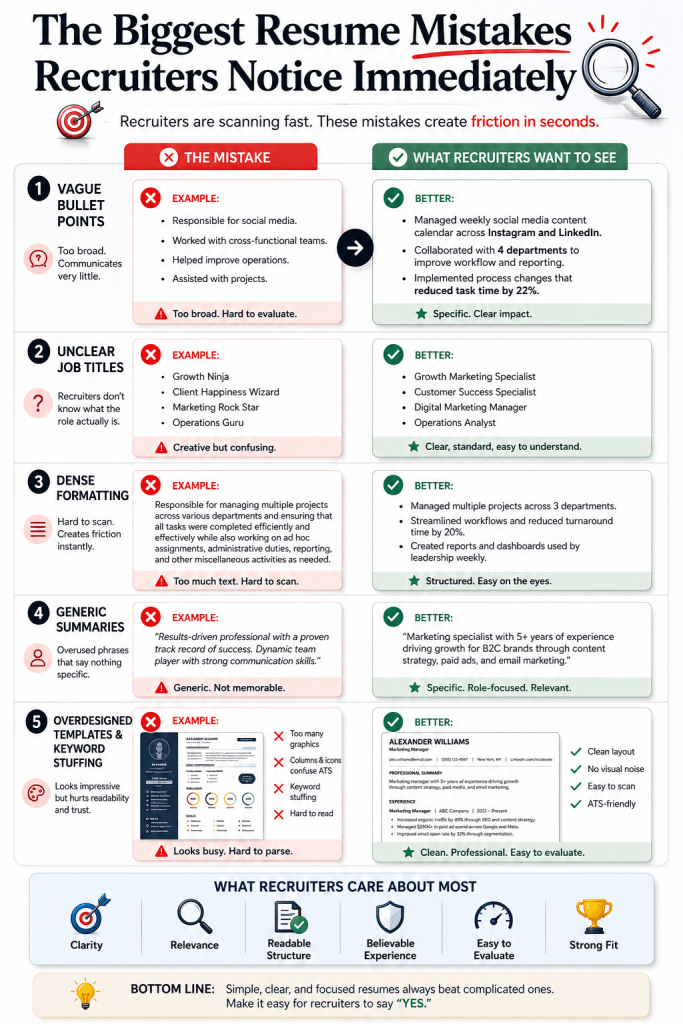
3. Dense Formatting
A resume can contain strong experience and still become difficult to review because of formatting.
Common problems include:
- giant paragraphs
- very small font sizes
- crowded spacing
- excessive bolding
- too many sections
- visual clutter
When resumes feel visually dense, recruiters often have to work harder to find important information.
And in high-volume hiring environments, additional effort can become a problem.
Readable resumes usually feel:
- structured
- calm
- easy to navigate
- visually consistent
Good formatting helps recruiters process information faster.
4. Too Much Old Experience
A lot of candidates try to include every role they have ever had.
The result is often resumes that:
- become too long
- lose focus
- bury relevant experience
- overwhelm the reader
Older experience is not automatically bad.
The issue is relevance and prioritization.
If someone is applying for mid-level marketing roles, recruiters usually care more about:
- recent experience
- current tools
- recent responsibilities
- modern workflow familiarity
than unrelated jobs from 15 years ago.
A focused resume is usually easier to evaluate than an exhaustive life history.
5. Generic Professional Summaries
This section often becomes overloaded with vague corporate language.
Examples:
- “Results-driven professional”
- “Dynamic team player”
- “Strategic thinker”
- “Highly motivated individual”
These phrases appear on thousands of resumes.
Because of that, they rarely help candidates stand out meaningfully.
Strong summaries are usually:
- shorter
- clearer
- role-focused
- easier to understand quickly
For example:
“Operations coordinator with 4 years of experience supporting logistics and vendor communication in fast-paced retail environments.”
That communicates much more clearly than several lines of abstract professional language.
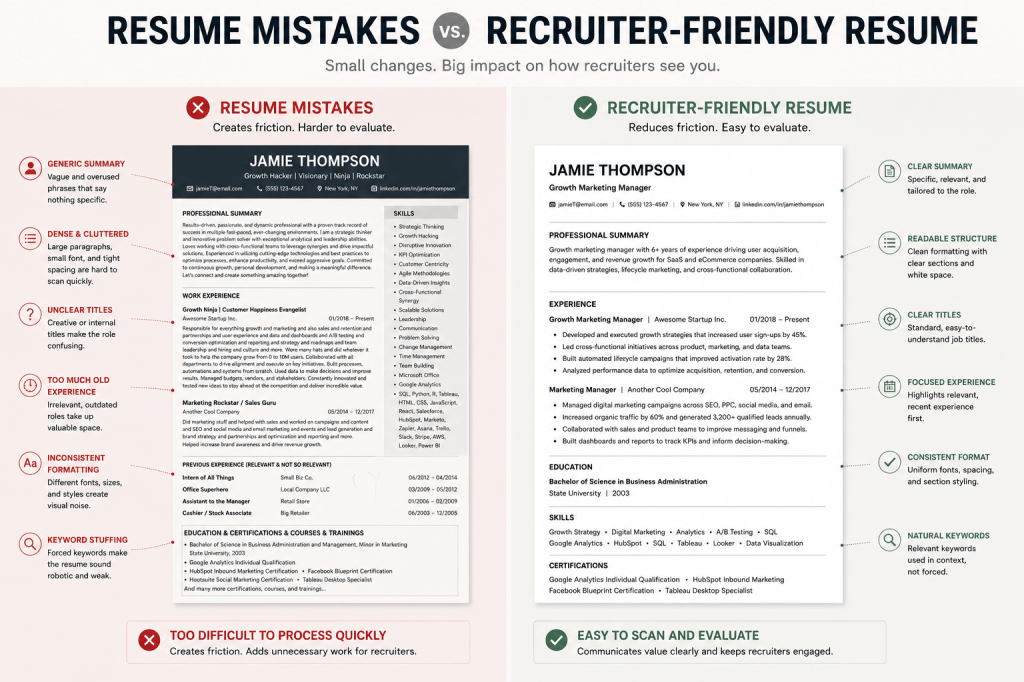
6. Overdesigned Resume Templates
This has become increasingly common online.
Many resume templates now prioritize:
- aesthetics
- branding
- graphics
- visual uniqueness
instead of readability.
Things like:
- icons
- progress bars
- columns
- excessive colors
- decorative layouts
can create friction during both:
- recruiter review
- ATS parsing
Simple formatting is often more effective because recruiters already know how to navigate it quickly.
Overdesign can slow comprehension instead of improving it.
7. Keyword Stuffing
A lot of candidates become so focused on ATS optimization that the resume starts sounding unnatural.
This usually looks like:
- repetitive terminology
- giant skills sections
- copied job descriptions
- excessive buzzwords
Relevant keywords matter.
But resumes still need to feel readable and believable to actual people.
Over-optimization often makes resumes harder to trust.
8. Endless Editing
One hidden problem with online resume advice is that candidates start endlessly rewriting resumes trying to achieve “perfect” wording.
Eventually the resume becomes:
- inconsistent
- overly polished
- unnatural
- difficult to read smoothly
At some point, more editing stops improving clarity.
Most strong resumes are not perfect.
They are:
- understandable
- relevant
- readable
- easy to evaluate quickly
That is usually enough.
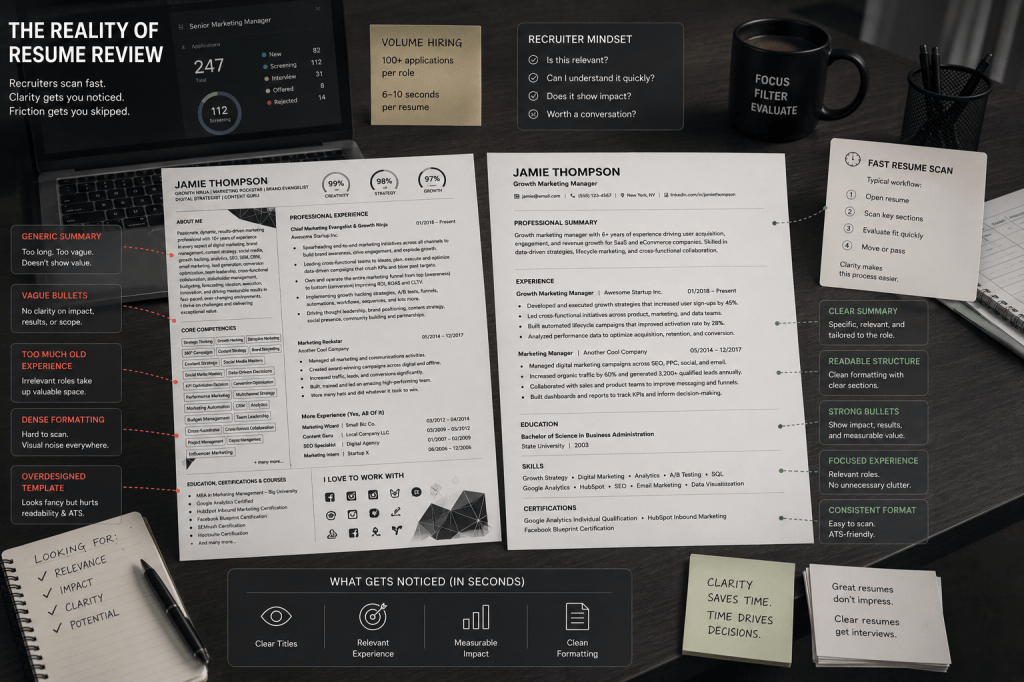
What Recruiters Actually Respond To
Most recruiters are not looking for:
- the most visually unique resume
- the smartest wording
- the most aggressive branding
- the “perfect” template
They are usually looking for:
- clarity
- relevance
- readable structure
- believable experience
- easy evaluation
That process is much more practical than many candidates realize.
Final Thoughts
Many resume mistakes happen because candidates try too hard to:
- impress
- optimize
- stand out
- sound more professional
Ironically, those efforts often create more friction.
The strongest resumes are usually the ones that:
- communicate clearly
- feel structured
- reduce confusion
- make recruiters work less
In modern hiring, clarity consistently outperforms unnecessary complexity.
If you’re actively applying right now, focus on making your resume easier to understand before trying to make it more impressive.
The ATS-safe templates and recruiter-focused resume frameworks in The DIY Job System were designed around exactly that principle.
Use the free Resume Application Checklist before your next application.
 thediyjobsystem
Leave a comment